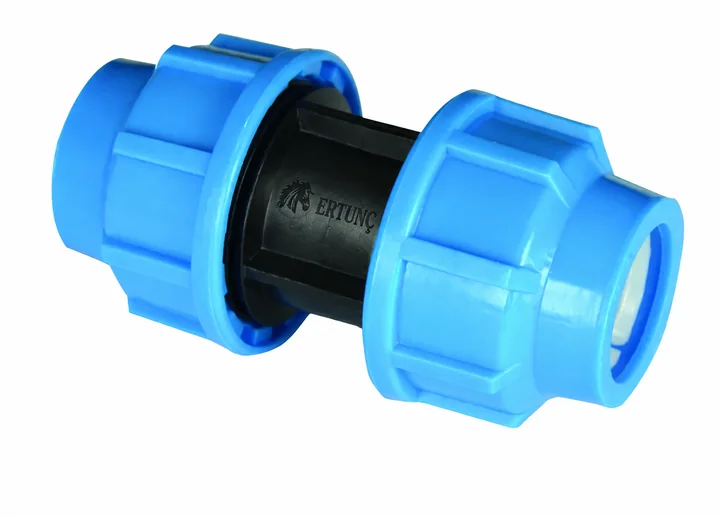
Coupling, Reducing Coupling or Threaded Adaptor: Which Fitting?

Asking for a “coupling” may identify a general fitting category rather than one specific part. A reliable parts list explains what the fitting must do, the connection type at each end and both sizes. This prevents a familiar trade name from hiding an important mismatch. For practical symptoms, also review the checks for fitting leaks.
Joining equal pipe sizes: straight coupling
Consider a suitable straight coupling when two pipe ends must be joined in line. On a compression connection, each pipe-side size is matched to the compatible pipe outside diameter. Equal sizes do not remove the need to check the connection system.
Do not assume an ordinary coupling is a repair coupling. Available installation movement, the product construction and the manufacturer’s instructions must be assessed by the installer.
Joining unequal sizes: reducing coupling
A reducing fitting connects two different sizes. State the larger and smaller sides together; the larger dimension alone cannot identify the part. Also specify whether each connection is compression or threaded.
Reducing a diameter does not automatically improve the required flow or pressure. Hydraulic suitability needs separate evaluation; identifying a fitting is not a substitute for designing the line.
Changing from pipe to thread: adaptor
Record the pipe-side size separately from the nominal thread size. A male adaptor has an external threaded end; a female adaptor has an internal threaded end. Confirm the mating thread size and standard as well.
Terms such as union, nipple and adaptor describe different functions and may be used loosely in enquiries. A product code or clear photographs of both ends provide a more reliable reference than a trade name alone.
A series name does not approve the whole system
Find the required function within the Blue PN16, New PN16, metal or PP threaded fitting groups, then check the exact code and size. A designation on one fitting does not establish the working limits of the complete pipe assembly.
Consider pipe material, operating conditions and the other components. Do not infer metal grade, seal material or certification from appearance when the catalogue does not explicitly state it.
Write a clear quotation line
Include function, series or code, first-end type and size, second-end type and size, quantity and any pack requirement. If a turn or branch is needed, identify an elbow or tee separately rather than requesting a straight coupling.
Fittings use their own unit or pack quantities; hoses and pipes are sold in full coils. Stock, pack contents and delivery details are confirmed with the quotation. Separate lines for mating parts also make prices easier to compare.
Related products and sizes
- Blue PN16 Compression Fittings
- New PN16 Compression Fittings
- PP Threaded Fittings
- Metal-Insert Compression Fittings
The cover is an illustrative product scene, not a real site record, installation instruction or product test.
Frequently Asked Questions
Does “coupling” always identify one exact fitting?
No. The term may describe a broader fitting group. State the function, end types, dimensions and product code wherever possible.
Is one dimension enough for a reducing fitting?
No. Both dimensions and connection types are required. The larger size alone does not identify the correct part.
What information identifies a threaded adaptor?
Provide the pipe-side size, nominal thread size, male or female form and the required mating thread standard.
Confirm the size and supply scope
Share the product, size, full-coil or fitting quantity and destination. Stock and technical suitability are confirmed in the written quotation.