How to Connect Polyethylene Pipe: Step by Step
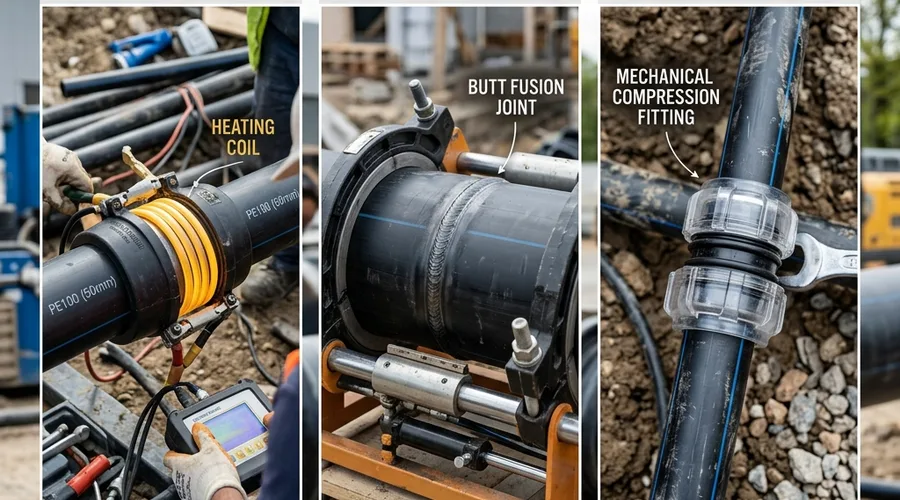
PE Pipe Connection Methods
The correct connection method is the basis of a leak-free and long-lasting water line.
Explore the relevant options: Explore couplings and pipe fittings · Compare coiled-pipe sizes and classes
Comparison of 3 Connection Methods
| Method | Diameter Range | Difficulty | Reliability |
|---|---|---|---|
| Mechanical Fitting | 20-63mm | Easy ⭐ | Good |
| Electrofusion | 20-315mm | Medium | Very good ⭐ |
| Butt Weld | 63mm+ | Hard | Perfect ⭐ |
Step by Step Mechanical Fitting Installation
- Cut pipe straight, remove burr
- Disassemble the fitting and note its order
- Insert the pipe into the fitting
- Tighten the nut by hand, then turn 1/4 with the wrench.
- Do a pressure test
Related Guides
Ertunç Plastik polyethylene pipe
All diameters between 20mm-110mm PE 100, PE 100 16 ATÜ, blue polyethylene pipe and black polyethylene pipe We produce pipes. Current prices Click for.
Frequently Asked Questions
How to connect polyethylene pipe?
PE pipe can be joined using suitable mechanical couplings, electrofusion or butt fusion. Selection depends on pipe and fitting compatibility, pressure class and project conditions, not diameter alone. Follow the selected system’s instructions; no method is automatically the strongest or sufficient for every domestic application.
What are PE pipe fittings?
Elbow (90° and 45°), tee, reducer, coupling, cover, valve, adapter and clamp are the main additional parts. It is critical to choose a part suitable for the pipe diameter.
What is electrofusion welding?
Electrofusion uses electrical heating elements within a fitting to fuse it to compatible PE pipe. Verify the permitted diameter and SDR range in the fitting data. A trained installer must follow the approved procedure for surface preparation, alignment, fusion and cooling.
How to do butt welding?
Butt fusion joins prepared and aligned compatible PE ends through controlled heating and joining. The permitted diameter and wall-thickness range depends on the pipe, equipment and approved procedure; there is no universal minimum diameter for every product. Suitable equipment and a trained installer are required.
What is mechanical fitting?
A mechanical coupling joins compatible pipe without heat fusion, using sealing and gripping components. Check the supported outside diameter, pressure class and required tools in the product data. Not every model is hand-tightened or assembled in the same way; follow its nut and seal installation instructions.
What are the most common mistakes in PE pipe connection?
The most common mistakes are not cutting the pipe end properly, not cleaning the burr, incorrectly tightening the fitting, using incompatible diameter/material and skipping the pressure test.
How to cut polyethylene pipe?
Use cutting equipment approved for the pipe. Prepare a clean, undistorted end square to the pipe axis, and follow the joining system’s instructions for removing burrs and addressing surface damage. Check end dimensions, ovality and insertion depth before joining.
What to do if PE pipe connection leaks?
First shut down and depressurise the line safely. Investigate pipe and fitting dimensions, seals, surface damage and assembly to identify the cause. Replace a damaged or defective fused joint using an approved repair procedure; wrapping tape around it is not a pressure-pipe repair. Arrange a suitable leak check before returning the system to service.
Which glue to use for PE pipe?
Do not treat standard PVC solvent cement as an approved joining method for PE pressure pipe. Use a fusion or mechanical system approved for the pipe and application. Any proposed specialist adhesive requires explicit technical approval for that PE pressure-pipe application.
What should be considered in polyethylene pipe installation?
Prepare the trench, bedding, cover and backfill for the project conditions. Place the pipe without damage, follow the appropriate joining procedure and complete the tests required by the specification. Check for sharp objects, crushing and excessive bending; one backfill recipe or burial depth does not suit every ground condition.
What to do if a mechanical fitting leaks?
Do not tighten or dismantle the connection while it is pressurised. Check outside-diameter compatibility, insertion depth, seal and gripping-component positions, and the pipe surface. Replace damaged parts and reassemble to the manufacturer’s tightening instructions. Sealant permitted on a threaded end is not a substitute for the seal around the pipe.
Is an electrofusion welding machine necessary?
An electrofusion fitting requires a compatible control unit and preparation tools. The need for fusion, or the suitability of a mechanical coupling, cannot be decided from a single diameter threshold; assess the pipe, SDR, pressure class and project requirements together. Fusion work requires suitable equipment and a trained installer.
Can PE pipe be joined with adhesive?
Do not assume general-purpose adhesive or PVC solvent cement provides an acceptable joint in PE pressure pipe. Suitable fusion and mechanical systems are the usual options. Any alternative method requires explicit technical approval for the particular product and application.
How to make polyethylene pipe elbow connection?
Select the elbow for the pipe outside diameter, material, pressure class and joining method. Confirm whether a mechanical or fused elbow suits the product and project. Pipe flexibility does not allow unlimited bending; for a bend without an elbow, check the manufacturer’s permitted bend radius and loading on the joints.
What should be the pipe welding temperature?
There is no single fusion temperature and timing rule for every PE pipe. Follow the approved procedure for the pipe and fitting material, diameter, SDR, machine and site conditions. For electrofusion, use the fitting’s specified parameters and equipment instructions; do not adjust settings by guesswork.
Related Products and Sizes
Jump directly to the relevant product family, measurement sheets and complementary technical guides.
Product and technical guide network
Examine the topic along with product family, measurement and application guides.
Check out our products
Discover the hose and pipe products that suit your needs.