How Much Water Can PE Pipe Carry? Flow Calculations for 20–63 mm Pipe
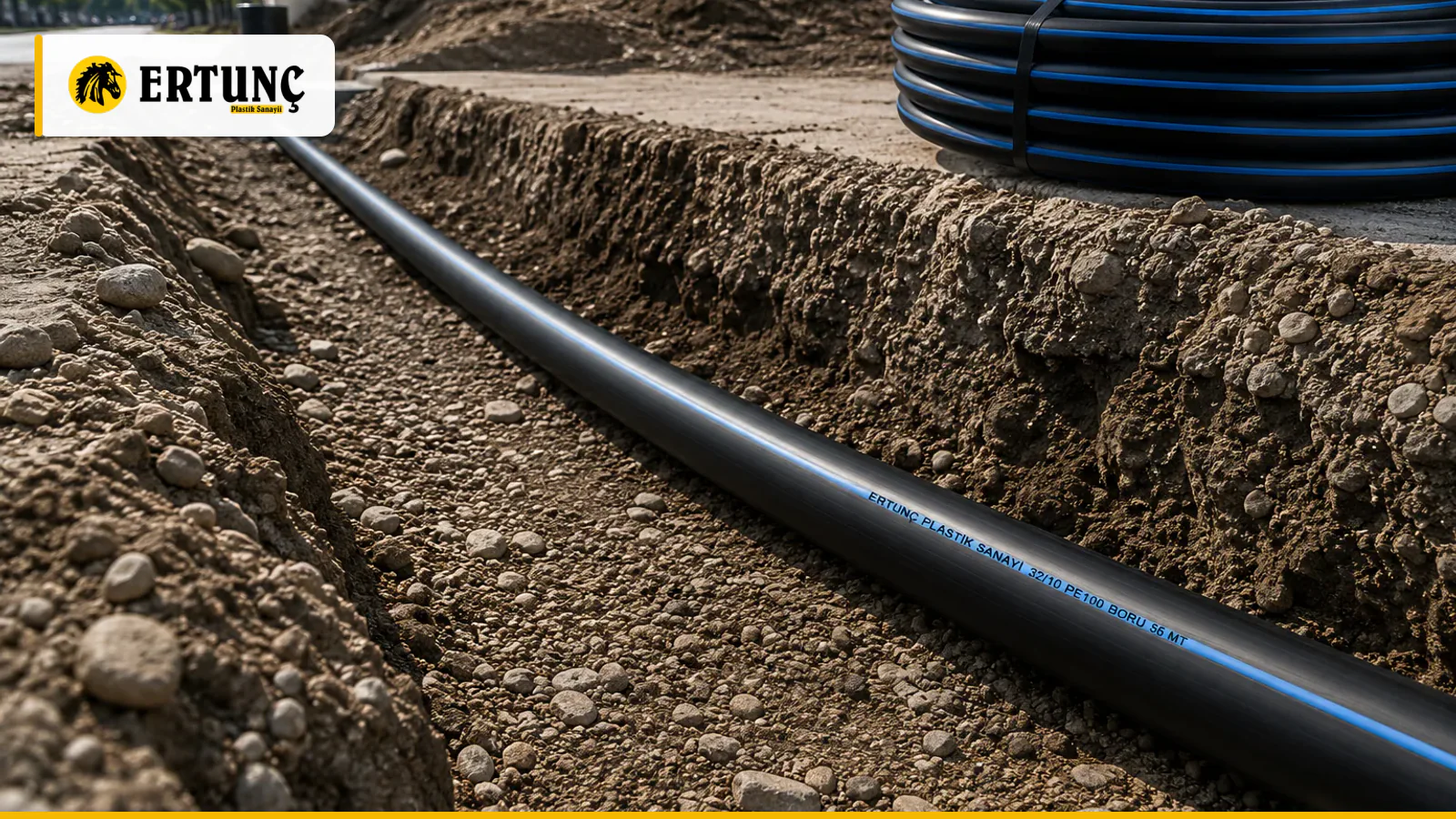
There is no single answer to “How much water can a 32 mm pipe carry per hour?” The stated 32 mm size usually means the outside diameter. The actual internal diameter depends on the PE grade, SDR or ATÜ class and wall thickness. Estimating flow requires the internal diameter, water velocity, pipe length, elevation difference and pump curve to be considered together.
Explore the relevant options: Open the flow and pipe-diameter calculator · Compare coiled-pipe sizes and classes
Are tonnes per hour and cubic metres per hour equivalent?
For practical water calculations, 1 m³ is approximately 1 tonne. A water flow of 5 tonnes per hour therefore corresponds to approximately 5 m³/h in many irrigation calculations. This approximation applies to water; it must not be carried over to fluids with a different density.
Pressure and flow rate are different quantities. ATÜ or bar is used to describe pressure or a pressure class, while flow rate is the volume of water passing in a given time. A higher pressure rating on a PE100 polyethylene pipe does not, by itself, guarantee a higher flow rate.
Why do sizes of 20, 25, 32, 40, 50 and 63 mm not specify a flow rate?
PE pipe is usually sold by outside diameter. Pipes marked 6 ATÜ, 10 ATÜ or 16 ATÜ can have different wall thicknesses at the same 32 mm outside diameter, leaving different internal flow areas. A single tonnes-per-hour figure for every 32 mm pipe would therefore be misleading.
Theoretical Flow by Internal Diameter
The values below are theoretical examples for a full pipe at a water velocity of 1 m/s, without accounting for losses. In a real system, elbows, couplings, valves, filters, pipe length, elevation difference and pump capacity can reduce the flow achieved. Use the actual internal diameter, not the product outside diameter, when reading this table.
| Actual internal diameter | Approximate flow at 1 m/s | Approximate equivalent in tonnes per hour |
|---|---|---|
| 16 mm | 0.72 m³/h | 0.72 tonnes/h |
| 20mm | 1.13 m³/h | 1.13 tonnes/h |
| 26 mm | 1.91 m³/h | 1.91 tonnes/h |
| 33 mm | 3.08 m³/h | 3.08 tonnes/h |
| 41 mm | 4.75 m³/h | 4.75 tonnes/h |
| 52 mm | 7.65 m³/h | 7.65 tonnes/h |
Formula: flow rate (m³/h) = internal cross-sectional area (m²) × water velocity (m/s) × 3,600. Doubling velocity increases the theoretical flow, but friction losses and the risk of water hammer can also increase sharply.
How do you choose between 32, 40, 50 and 63 mm pipe?
A short garden line, a field irrigation line hundreds of metres long and a pump serving a large elevation difference require different assessments. First calculate the combined flow of the outlets that will operate at the same time. Then check the actual internal diameter and total head loss along the line.
- 32 mm PE100 pipe: may suit low-flow branches or short runs where the project calculations support its use.
- 40 mm PE100 pipe: can provide a larger flow area than 32 mm pipe; the actual benefit depends on wall thickness and line length.
- 50 mm PE100 pipe: may be considered for higher target flow rates or longer runs.
- 63 mm PE100 pipe: is commonly considered for mains, longer runs or lines serving several outlets.
These examples do not constitute a completed design. Use the pipe diameter calculator for a preliminary assessment, then verify the result against the pump curve.
How do length, elevation and fittings affect flow?
Longer pipe runs increase friction loss. An upward elevation change adds static head. Restrictive couplings, unnecessary elbows, partly closed valves and dirty filters also reduce the available pressure. A flow measured on a 10 metre test line should therefore not be assumed for a 300 metre field installation.
A pump’s maximum catalogue flow is not enough to size the system. Flow varies with the head against which the pump operates. The duty point depends on the pump curve, suction conditions and total dynamic head. ATÜ pressure class selection and flow calculation are separate steps, but both must be checked for the same project.
7 Inputs for a Useful Site Calculation
- Measure the total pipe length and the highest elevation difference.
- Find the total flow rate of drippers, sprinklers or outlets that will operate simultaneously.
- Get the make-model and operating curve of the pump.
- Verify the outside diameter, ATÜ/PN and SDR or wall thickness of the pipe.
- List elbows, valves, filters, couplings and constrictions.
- Note the targeted run time and water temperature.
- Check the selection against the SDR, PN and ATÜ guide before finalising it.
Related products, dimensions and technical guides
Frequently Asked Questions
These 18 questions explain PE pipe flow for 20–63 mm sizes, with the product and installation details needed to interpret the calculations.
How much water can a 20 mm PE pipe carry per hour?
If 20 mm denotes the outside diameter, the flow depends on wall thickness. In a theoretical example with an actual internal diameter of 16 mm, a velocity of 1 m/s gives approximately 0.72 m³/h. Pipe-system losses must be calculated separately.
How much water can a 25 mm pipe deliver per hour?
An outside diameter of 25 mm is not enough to determine flow. A reliable tonnes-per-hour figure also requires internal diameter, water velocity, line length, elevation difference and the pump duty point.
How much water can a 32 mm pipe carry per hour?
The 32 mm size usually means outside diameter. If the internal diameter is 26 mm, for example, a theoretical velocity of 1 m/s gives approximately 1.91 m³/h. Different ATÜ classes and wall thicknesses change the result.
How much water can a 40 mm PE pipe carry?
For an idealised pipe with an actual internal diameter of 33 mm and no losses, a velocity of 1 m/s gives approximately 3.08 m³/h. This illustrates the calculation method; it is not a guaranteed product flow rate.
How much water can a 50 mm polyethylene pipe deliver per hour?
With an assumed internal diameter of 41 mm, a theoretical velocity of 1 m/s gives approximately 4.75 m³/h. Long runs, elbows, filters and elevation differences can reduce the actual flow.
How much water can a 63 mm PE pipe carry per hour?
With an assumed internal diameter of 52 mm, a theoretical velocity of 1 m/s gives approximately 7.65 m³/h. A project-specific result requires the actual SDR/ATÜ class, pump characteristics and line losses.
How many cubic metres are in 1 tonne of water?
For practical calculations with water under normal conditions, 1 tonne is approximately 1 m³. Tonnes per hour and cubic metres per hour can therefore be used as approximate equivalents for water.
Does the flow rate increase as the pipe diameter increases?
At the same speed and conditions, as the internal section increases, the flow rate that can be carried increases. However, if the pump capacity is insufficient, enlarging the pipe alone does not guarantee the target flow rate.
Does the pipe carry more water as ATÜ rises?
No. ATÜ describes a pressure class. At the same outside diameter, a higher pressure class may require a thicker wall, reducing the internal diameter.
Is the flow rate of PE100 and PE32 pipes the same?
The wall thickness and actual inner diameter of two products with the same outer diameter may be different. Flow rate comparison is made based on the inner diameter and line calculation, not the material name.
How much does the pressure drop in a 100 meter pipe?
Pressure loss depends on internal diameter, flow rate, internal surface condition, fittings and water temperature. There is no universal fixed value; a hydraulic loss calculation is required.
Does elevation difference reduce water flow?
Yes. As the line rises, the static head the pump must overcome increases, which can reduce flow at its duty point.
If the pump outlet is 2 inches, what size should the pipe be?
The pump nozzle alone does not make the decision. Target flow rate, line length, pump curve and allowed speed are evaluated together.
Is outer diameter or inner diameter written on polyethylene pipe?
PE pipe sizes such as 20, 25, 32, 40 on the market mostly refer to the outer diameter. Wall thickness or SDR/ATÜ should also be written in the order.
How to choose diameter in drip irrigation main line?
Total dripper flow rate, simultaneously operating sections, line length, elevation and allowable pressure difference are calculated together.
Does the pipe diameter calculator provide a final engineering design?
The calculator supports preliminary selection. Critical, long, buried or high-pressure lines require the result to be checked against the pump curve and engineering calculations.
Are elbows and valves important in flow rate calculations?
Yes. Each connection can create local loss; Narrow-pass parts, dirty filters and half-open valves can significantly increase loss.
What information should I give to Ertunç Plastik for the ton/hour calculation?
Share pipe size and ATÜ, total length, elevation difference, target flow rate, pump model, water source and number of connections.
Related Products and Sizes
Jump directly to the relevant product family, measurement sheets and complementary technical guides.
Let's Choose the Right Product Together
Share application, diameter, length and delivery information.