Spiral Hose
Why does a yellow suction hose flatten or collapse?
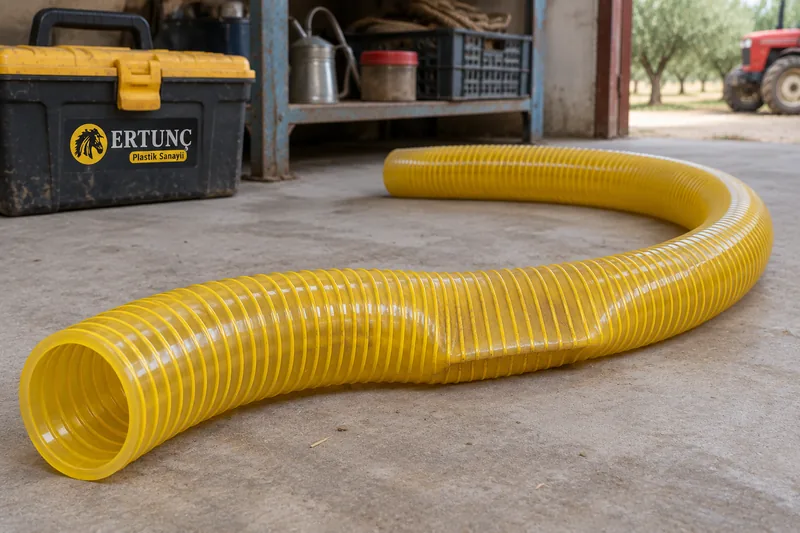
If part of a hose flattens when the pump runs, checking the water output alone is not enough: the flow passage may be narrowing. A product sold as a suction or intake hose is not automatically suitable for every vacuum and temperature condition.
Quick answer
Stop the pump and make the line safe and pressure-free. Check tight bends, restrictions at the intake and permanent hose damage first. Selection requires the hose’s verified vacuum, temperature and minimum bend-radius information; colour or apparent wall thickness alone is insufficient.
Symptoms and checks
| Symptom | Check | Action |
|---|---|---|
| Flattening at one bend | Tight routing or external load | Relax the route and inspect damage |
| Long section narrows when running | Vacuum suitability and intake restrictions | Review inlet conditions and product limits |
| Flattening remains after stopping | Permanent wall or reinforcement damage | Remove from service for assessment |
| Noise and low flow without visible collapse | Air ingress or another pump problem | Use the air ingress and cavitation guide |
1. Suction and discharge are different duties
On the suction side, pressure inside the hose can fall below the surrounding pressure. The wall must retain its shape under that condition. Suitability for positive discharge pressure does not establish suitability for vacuum; the two duties need separate confirmation.
This guide concerns visible hose deformation. If the hose keeps its shape but the pump is noisy or flow is irregular, use the air ingress and cavitation guide. Not every low-flow problem is a collapsed hose.
2. Check tight bends and external loads
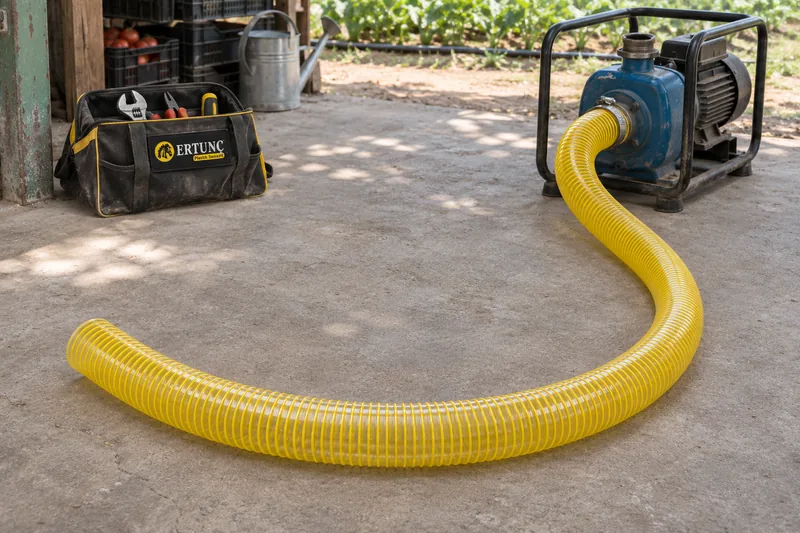
Inspect abrupt turns at the pump inlet, threshold crossings and places where another object presses on the hose. A tight bend can change a round section into an oval. With the system stopped, relieve the route without twisting the hose about its axis.
The minimum bend radius depends on size and construction. Do not transfer a centimetre value from an unrelated hose. If the fitting pulls the hose sideways, also check hose-tail and inside-diameter compatibility.
3. Look for an intake restriction
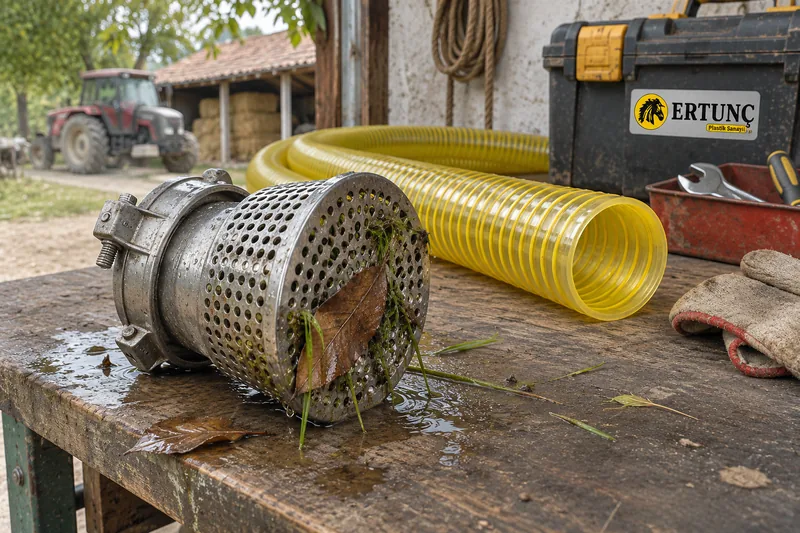
Leaves, mud or debris can restrict entry. Stop and isolate the system before examining the strainer and accessible inlet. Removing the strainer from service is not a permanent fix; clean and refit it according to the pump instructions.
Do not repeatedly restart a collapsing hose merely to see whether flow improves. The system review should also consider suction height, line length and restrictive connections.
4. Does the deformation remain when stopped?
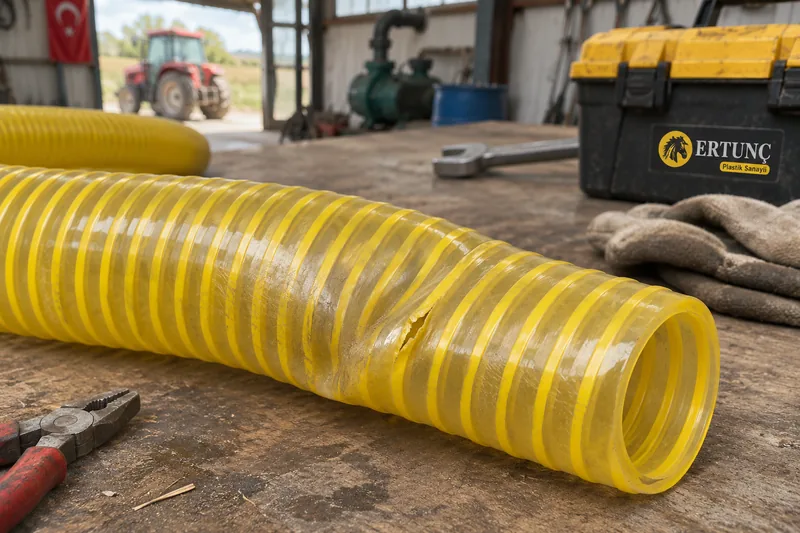
A lasting crease, crack, abrasion or damaged reinforcement needs assessment before reuse. Tape, heating the hose back into shape or inserting improvised wire does not restore a verified vacuum rating.
Remove damaged hose from service and select a compatible replacement. A heavy suction hose may be considered for some applications, but the name or a thicker appearance is not a vacuum specification.
5. Include temperature and storage history
Operating temperature can affect hose behaviour. Record fluid temperature separately from ambient heating by sunlight or hot surfaces. A safe temperature limit cannot be inferred from appearance; use verified product data.
Store in generous coils on suitable supports, protected from crushing loads. Do not skip inspection after long storage or when vehicles have passed over the hose.
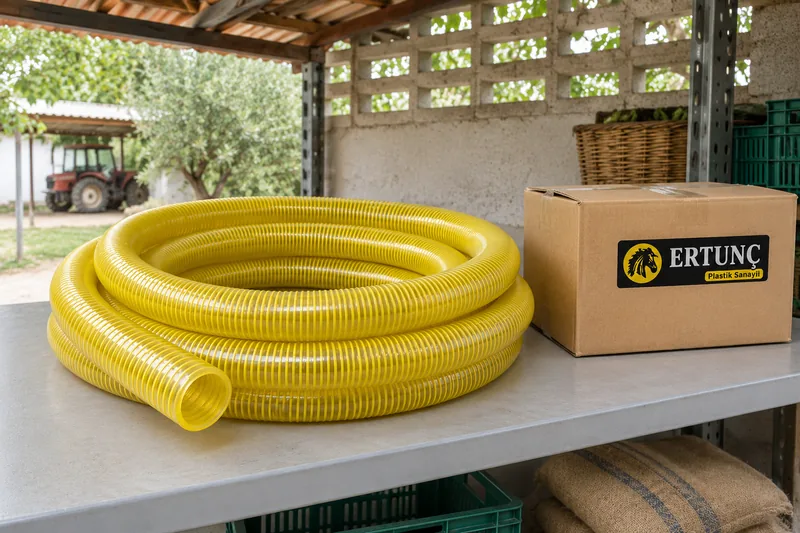
6. What to specify for 1½, 2, 3 or 4 inch hose
When selecting standard yellow suction hose, provide inside diameter, fluid, temperature, line length, suction conditions and connection type together. A larger diameter is not automatically a direct match for an existing pump.
Standard 1½ and 2 inch packs total 50 metres in a 25 + 25 arrangement; this is not a continuous 50-metre run. Standard 3 and 4 inch coils are 24 metres. State the purchasing quantity separately from any uninterrupted length requirement and plan the connections.
If the problem is separation from the fitting rather than flattening, use Why does a pump hose keep coming off? Check the fitting and clamp.
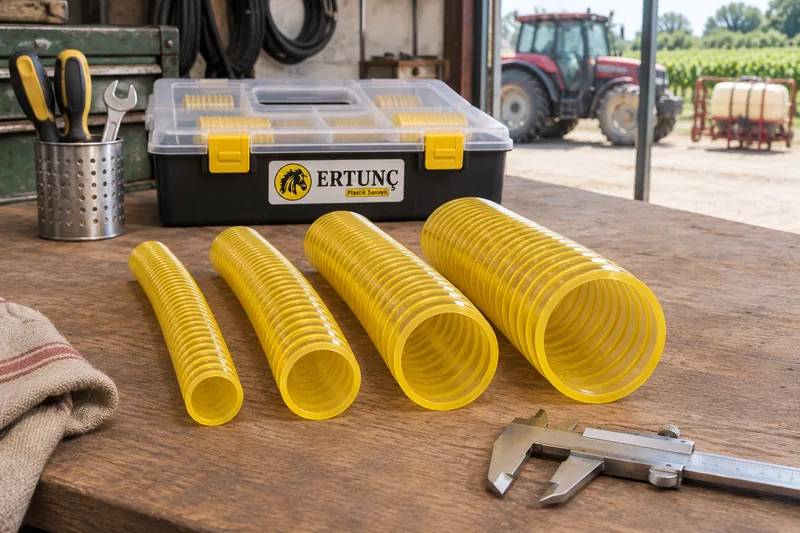

Related products
1 1/2″ Standard Yellow Suction Hose
1½ inch; standard total pack 50 m (25 + 25). Confirm application suitability.
2″ Standard Yellow Suction Hose
2 inch; standard total pack 50 m (25 + 25).
3″ Standard Yellow Suction Hose
3 inch; standard coil 24 m.
4″ Standard Yellow Suction Hose
4 inch; standard coil 24 m.
Frequently asked questions
Does yellow colour prove vacuum suitability?
No. Colour is not a vacuum rating. Verified information is needed for the size, construction, temperature and bending conditions.
Can I keep using a hose that returns to shape when stopped?
Returning to shape does not establish that the problem is resolved. Check service conditions and possible damage before restarting.
Will a thicker or heavy-series hose definitely solve it?
Not necessarily. Intake restrictions, routing and system conditions also need attention, and the replacement’s suitability must be verified.
Is the 50-metre pack one continuous length?
For the standard 1½ and 2 inch spiral products discussed here, 50 metres is the total in a 25 + 25 arrangement. State uninterrupted-length needs separately when ordering.
Two related guides
Air ingress and cavitation in a pump suction line
Assess symptoms without visible collapse separately.
Heavy suction hose: pump and vacuum selection
Choose the series by service conditions, not colour or thickness alone.
Request a quote with your product and size
Include the product size, coil count, line length and delivery location so we can review a suitable option.
Send your quote requirements